He Went to Mars to Escape His Landlord. He Accidentally Saved the Colony.
Doug Whitaker is fifty-one years old, twice divorced, and very good at exactly one thing. When you call to cancel your car insurance, they put him on the phone, and he talks you out of it. He has been in the top three on a floor of two hundred and six people for nine years running. It is not a thing anybody is proud of. It is the only thing he has.
Then his landlord bills him for the wifi. Not the wifi in the building, which nobody uses. The wifi. As a concept. And Doug, six beers deep at a bar with a plate of fried pickles at his elbow, fills out an application to leave the planet on the bar’s guest network because he thinks it will be funny.
Eleven days later he gets in.
Mars is not what the commercials promised. Perseverance Municipal Settlement is eight thousand people living inside a buried industrial park with hallways the color of a tooth. The air is metered and billed. Every activity has an oxygen budget calculated off a table in an appendix, and there is no line on that table for dancing, because in twenty-eight years nobody has ever asked permission to move on purpose. There is a permit for hanging a picture, and the office that issues it is window four, and window four is closed. Doug gets assigned to the garbage line, and he sorts metal from polymer from organic for four months before he notices the thing that changes his life, which is that in all that time he has not heard one single person laugh out loud.
So at a birthday party in a cargo bay, standing on a crate with a warm beer, he announces that what this planet needs is a strip club.
Twenty-six people laugh for a solid minute. It is the biggest laugh anyone on Mars has had in half a year. And Doug climbs down off that crate understanding something nobody else in the room has caught, which is that they were not laughing at the joke. The joke was not that good. Every one of them had just pictured a room with people in it, and it had been so long since any of them had been in one that the picture alone put the whole party on the floor.
What follows is the least likely construction project in the history of the human species. A condemned soy dome nobody has wanted in eight years, leased for nineteen credits a day because there is a gray-green fungus rotting in the wall seams that made the building useless for growing food. Forty-one investors, not one of whom has any money, who pay instead in stolen conduit and stage steel and favors owed at the fabrication shop. A welder from Louisiana who will only invest if there is karaoke, and who is extremely serious about this. A machinist from Bowling Green who has been carrying the correct bag weight for low-gravity cornhole around in a notebook for twenty months, because there was nowhere on the entire planet to set a board down.
And a compliance auditor named Bunny LaRue, who stands up at a public morality hearing and dismantles Doug’s business plan in four minutes flat, line by line, with numbers. Then she waits for him in the hallway, tells him every single thing he got wrong in order, and he realizes she has just handed him the plan. When he asks why, she says she wants to see if he is stupid enough to come back.
He is.
The Landing Strip opens on a Friday in February with a permit for three hundred and eighty people, and six hundred and forty-one come, because there are three hundred more standing out in the corridor who did not get tickets and a crew chief points out that there is air out there too. Everything goes wrong. A dancer named Ruby Tatum, a gymnast who aged out of everything at twenty-two and went into the trades, pushes off a salvaged greenhouse strut in one third of Earth’s gravity and does not come down. She hits the ceiling truss nine meters up, catches it, hangs there, and starts laughing. Somebody smuggles contraband glitter into a colony where glitter fouls the atmospheric scrubbers, and the scrubbers foul, and the whole dome seals at a quarter to midnight and puts everybody out into the hallway.
And then six hundred people stand in that hallway until four in the morning and refuse to go home.
That is the whole book, right there. Everything after it is that same discovery getting bigger. Comedy night starts because Thursday is slow. A therapy group starts meeting Tuesday afternoons in the corner and calls itself a book club and has never once read a book, and in thirty years nobody ever asks a member what they are reading. A lending library appears because somebody left a paperback on a table. Candidates for the settlement council start campaigning in the building because it is the only room with a crowd in it, and turnout goes from nineteen percent to sixty-one. A baby gets delivered in the parking bay in eleven minutes, and the only reason everybody lives is that on any given night, in a room with four hundred people in it, one of them is a nurse.
Then a corporation from Earth decides that a settlement with one good room is a governance risk, and files a petition to have the Landing Strip legally classified as a non-essential atmospheric burden.
Then the sun does something, and eleven hundred and forty-two people get sealed inside a strip club for six days with the power down, and a bartender who has been on his feet for thirty-one hours pours a beer in the pitch dark and says who’s next.
And then a scientist working the bar for four times what her actual employer pays her figures out, while mopping a floor, that the fungus in the walls has been quietly making oxygen the entire time. That it wants heat, and humidity, and carbon dioxide, and moving air. That what it has wanted, for twelve years, more than anything in the world, is for somebody to put a packed, sweating, hollering room full of people inside it.
The more of them there are in there, the more air the whole settlement has.
I want to be honest about what this book is, because the title is doing a lot of shouting and the book underneath it is quieter than you would expect. It is ninety thousand words and it is a real novel. It is very funny, and it is funny about permits and forms and closed windows and small humiliating fees, which is a kind of comedy I do not think gets written enough. There is no sex on the page at any point. What there is instead is a middle-aged man with a bad knee and a bad divorce who is good at one useless thing, finding out at fifty-seven that the useless thing was a trade all along, and that it might be the only trade that matters out there.
Humanity did not survive on Mars because it perfected itself. It survived because people found reasons to gather, and argue, and laugh, and get married, and bury each other, and play a game with bags in it, and sit down next to somebody having the worst week of their life without saying anything about it.
Go find the room you go to for no good reason. Go there tonight. Sit down in it.
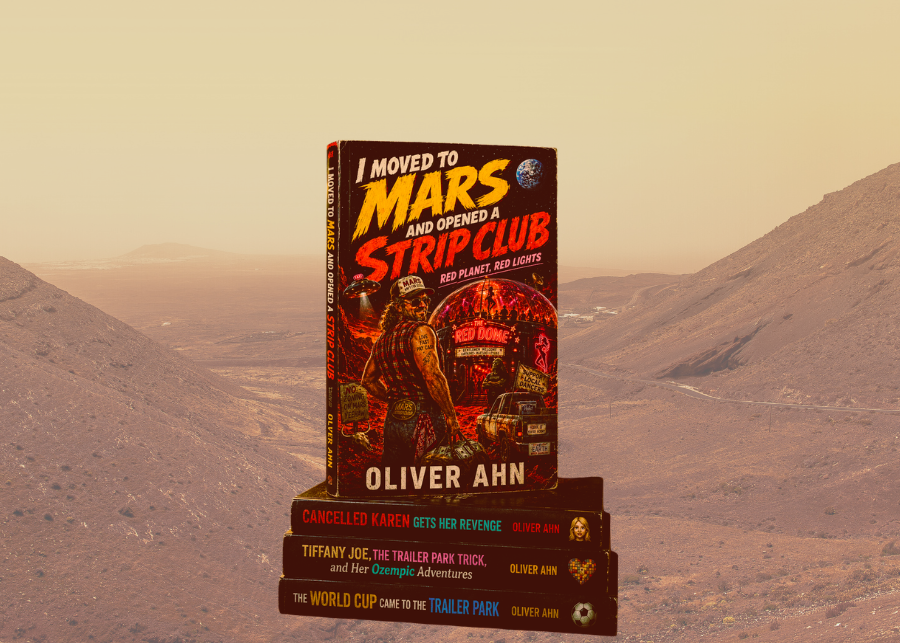
I Moved to Mars and Opened a Strip Club is out now on Kindle and in paperback. Ninety thousand words, thirty-two chapters, and one condemned soy dome.
More Unhinged Reads
- She Stole Death’s Ring. It Was Not, Technically, a Robbery.
- Funny Trailer Park Books: 12 Comedies Set in the Worst Zip Code in America
- Books and Authors Like Quan Millz: 16 Unhinged Reads That Go Just As Hard
- Meemaw Started a Meal-Prep Empire From the County Jail: A Dark Comedy About Hustle, Betrayal, and Sunday Dinner
New here? Start with Books Like Chuck Tingle: 10 Reads for When You Need More Absurd Love or Books About Influencers: 9 Novels About Going Viral and Regretting It.