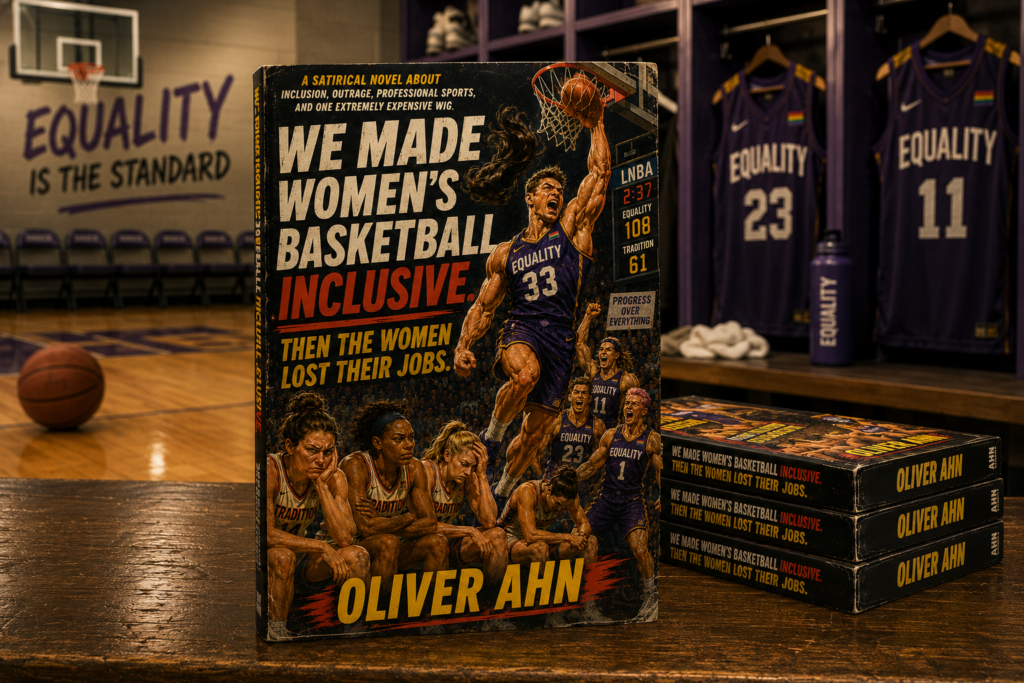
We Made Women’s Basketball Inclusive. Then the Women Lost Their Jobs.
Destiny Harper is thirty-four years old, twelve seasons into a career with the Atlanta Stampede, and she is old enough to remember when nobody came. She once played a professional game in an arena so empty she could hear a man in Section 103 unwrap a cough drop. The announced attendance was 4,800. She counted during free throws and got to about nine hundred, one of whom was asleep. Now there are kids at the rail holding signs with her name on them, and one of them, maybe eleven years old, tells her she shoots from too far away because her dad says those are bad shots. Destiny signs the jersey, tells the girl her dad is wrong, tells her to work on her left hand, and walks off toward the tunnel smiling. That is the league to her. Not the hashtags. Not the panels. A kid insulting her shot selection because she expects to be standing there someday.
Which is the problem, because the LNBA has finally gotten popular, and success is terrifying when your entire professional identity has been built around demanding it. The communications department goes from nine people to twenty-seven. Nobody knows what the additional eighteen do, including several of the additional eighteen. Every meeting acquires a facilitator, every facilitator acquires a presentation, and every presentation contains the words COMMUNITY, AUTHENTICITY, BELONGING, and COURAGE, sometimes all on one slide. The word BASKETBALL appears less often. The Stampede hire a culture and performance consultant named Maren who wears white sneakers that have never touched a gym floor and who asks the team to sit in a circle and write down one intention for the season. Destiny writes WIN. Maren explains that winning is an outcome. Destiny offers “score more points than them,” then “defend,” then finally “basketball,” and Maren decides basketball can work.
Then, at All-Star weekend, under a banner reading EVERY WOMAN. EVERY COURT. EVERY DREAM., Commissioner Skye Delgado announces a new eligibility pathway. The policy language is broad. Very broad. It does not define a competitive standard, and the applause starts before she finishes the sentence, and a beverage company changes its profile image within thirty seconds, which suggests either extraordinary moral reflexes or a social media manager who received the assets on Tuesday. Destiny does not clap fast enough. Then a reporter asks her a question at the podium, and she answers it, which is the single stupidest thing a professional athlete can do.
Ten minutes of questions become an eleven-second clip. No setup, no context, no dignity statement, no explanation. Her agent Marcus, a man with the permanent expression of someone watching his retirement account catch fire, tries to teach her the correct answers afterward on three fingers: I support everyone, I am listening and learning, I look forward to continuing conversations around this important issue. Destiny points out that this means nothing. Marcus says correct. She asks why anyone would say it. He says because it means nothing.
What follows is a witch trial run entirely by people who would describe themselves as kind. Her shoe sponsor pauses activation. Her beverage sponsor requests space for reflection. A skincare company she had forgotten she represented issues a statement about protecting vulnerable communities, and Destiny has to ask out loud what exactly they are protecting. Her teammate Tasha sends a private message reading I KNOW WHAT YOU MEAN and then posts publicly, five minutes later, that silence in moments like this is violence. Destiny screenshots the first and sends it back. Tasha replies: please don’t do that. The league suspends her pending review of comments inconsistent with league values. No rule violation is cited. Nobody identifies the prohibited sentence. The spectacle is the rule.
Everyone else in the league watches this happen and draws the correct lesson, which is not whether the witch was right. It is where the matches are kept.
Meanwhile, in an apartment somewhere, an agent named Leonard Finch is trying to sell Slovenia to a thirty-one-year-old unemployed center named Riley Brooks. Six foot seven, career average 4.2 points, eight years of men’s professional basketball across four countries and one season in Belgium he refuses to discuss. Leonard says the apartment is furnished. Riley asks if it has a couch. Leonard says it has a table. Riley says he asked about a couch. Then Leonard’s phone buzzes with an email about the LNBA’s new policy, and he reads it twice, and capitalism begins to stretch. Riley says he is not transgender. Leonard says he is merely observing that the league has created an application pathway with a subjective review process, and also that the minimum salary is significantly higher than Slovenia. Riley says that is suggesting. Leonard says he is suggesting nothing. Riley says you have suggestion eyebrows.
They file. Riley shows up for the photograph in a ninety-dollar wig from a beauty supply store and Leonard tells him he looks like the bass player in a 1987 hair metal band. Two weeks later Ryleigh Brooks receives provisional eligibility. League counsel Robert Chen, who has spent the entire book being the only person in any room asking what the actual rule says, walks into the commissioner’s office and offers her the legal answer or the answer with profanity. She picks legal. He says the framework operated as drafted. She asks for the other one. He says: we are so fucked.
At the first practice Ryleigh grabs a rebound, takes three dribbles, and dunks. By men’s professional standards it is a Tuesday. In that gym every head turns and the ball bounces away and nobody says anything. The clip is online before practice ends, five million views by lunch, ten million by dinner. The league reposts it with the caption THE GAME IS EVOLVING.
What happens next is not a conspiracy, and that is the sharpest thing about this book. Nobody coordinates. Coaches want wins. General managers want jobs. Owners want playoff games. Networks want highlights. Sponsors want reach. Fans want entertainment. The incentives coordinate on everyone’s behalf. Tiffany Nguyen goes from thirty-four minutes a night to nineteen. Danielle Washington goes from thirty-one to sixteen. Rebounding Rhonda Ellis, three-time league leader on the glass, watches six-foot-eight newcomers take balls off the rim above her head like adults getting cereal down from a high shelf for children. Coaches try to balance it. Balance lasts nine games. And the money goes up for everybody, which ruins the anger completely, because it is very difficult to lead a principled revolt when direct deposit has just improved. Danielle says she hates that her check is bigger. Tiffany says she loves that her check is bigger. Danielle says she hates why. Tiffany says she loves money independently of why.
Then Minnesota, dealing with two injuries, accidentally starts five pathway players on national television, the halftime graphic goes up, the color commentator stops speaking mid-sentence, her partner asks if she is okay, and she says “Wonderful.” America does the one thing the league had been praying it would not do. It starts counting. Numbers, as the book puts it, possess none of the emotional flexibility of press releases.
By the championship, nine of the ten projected starters came in through the pathway. The tenth is Keisha Monroe, thirty-four, five foot eight, twelve seasons. Outside the arena a seventy-four-year-old woman named Carol sits in a folding chair with a thermos, orthopedic shoes, and a sign reading I DIDN’T RAISE TWO DAUGHTERS FOR THIS SHIT. A man beside her holds one reading I SUPPORT BASKETBALL, and when a reporter asks his position he says Section 114. And late in the second quarter, after a dunk, Riley’s wig shifts, and he decides he is done, and he pulls it off in front of twenty thousand people and throws it into the stands, where a teenager catches it and holds it over his head like the Stanley Cup and informs security that THIS IS MINE. Then the others take theirs off, one by one, each removal producing another roar, until Leonard is standing beside the bench with four wigs at his feet looking like the manager of the world’s saddest beauty salon.
The second half is played with nobody wearing a wig and nothing happens. The scoreboard works. The referees officiate. Earth stays in orbit. For a few minutes basketball reclaims the building.
The best character in the book is Dragana Petrovic, a six-foot-eleven Serbian center with no media training whatsoever, who is asked at Media Day whether she believes she has a physical advantage and says yes, and asked to elaborate says “I am six eleven,” and then, watching three communications consultants have simultaneous spiritual emergencies, adds “America talk too much.” She wins the championship with thirty-eight points, twenty-four rebounds, eight blocks, and one destroyed folding chair, explains her success with the single word “Potassium,” and signs a banana endorsement that becomes the best advertising campaign in league history.
Then come the six committees, including the Women’s Basketball Preservation Task Force, which nearly collapses because several members object to the word women, prompting a retired star to ask what exactly they think they are preserving. Congress holds hearings, because elected officials who ignored half-empty arenas for thirty years discover lifelong passions for women’s basketball the moment television cameras arrive. And a seventy-three-year-old owner named Ruth Hanover looks around a boardroom and says, out loud, that these people are currently negotiating how many women should be required on a women’s basketball team.
This is a comedy, and it is a fast one, and almost every page is dialogue that moves like a sitcom with a mean streak. But the target is never the players. It is the machine: the consultants, the facilitators, the circle, the prewritten sentence everyone learns to say, the eleven-second clip, the room full of people who all privately agree and are each individually certain that speaking would cost them everything. The most damning thing in it is not a villain. It is a text message that says I get what you meant, sent privately, at night, by someone who will post the opposite in the morning.
Destiny’s answer at the end, when a young reporter asks what the league learned, is nine words long. Don’t make rules for applause. And if somebody asks what the rule actually means, don’t burn her at the stake.
More Unhinged Reads
- I Bought an AI Boyfriend and Programmed Him to Find My G-Spot
- Dark Humor Books: 14 Novels That Are Funny About Terrible Things
- Weird Books to Read When You Hate Everyone
- The End Times Are Cumming: Meet I Got Cucked by a Cryptid: Mothman
New here? Start with Books Like Chuck Tingle: 10 Reads for When You Need More Absurd Love or Books About Influencers: 9 Novels About Going Viral and Regretting It.