The Best AI Written Books, and How We Actually Use It
Most articles about AI written books are written by people who have never used it to write anything. They are either sure it is the end of literature or sure it is a toy. We use it every week, so this list is the other thing: what is actually out there, what is worth your time, and exactly how much of the work a machine really does.
Our own books are at the bottom, and we tell you plainly how they are made. If that is a dealbreaker for you, better you find out here than after you buy one.
The best AI written books so far
Sympathy Tower Tokyo, Rie Kudan
The most important one on this list. Kudan won the Akutagawa Prize, Japan’s most prestigious literary award, in January 2024, and then told the room that roughly five per cent of the book was ChatGPT text used word for word. The committee had already called it flawless. It is a novel about a high-rise prison built to house criminals in comfort, and the AI use is not a gimmick sitting on top of it, it is threaded into what the book is arguing about. If anyone tells you AI writing cannot produce literature, this is the book to hand them.
Death of an Author, Aidan Marchine
Aidan Marchine is the novelist Stephen Marche, and he says about ninety-five per cent of this 2023 crime novella was machine generated, using three different tools. It is a murder mystery about a dead novelist, which is a joke he is clearly enjoying. The interesting part is not whether it is good. It is that at ninety-five per cent you can still feel a human hand steering, and you can feel where it lets go.
1 the Road, Ross Goodwin
In March 2017 Goodwin drove from New York to New Orleans with an AI wired to a camera, a GPS and a microphone, printing what it produced onto rolls of receipt paper as the car moved. He published it in 2018 completely unedited, typos and all, because the point was the record and not the polish. It is honestly a difficult read. It is also the purest example of a machine writing a book with nobody tidying up after it, which makes it the control group for everything else here.
I Am Code, by code-davinci-002
Three writers spent about a year coaxing poetry out of an older OpenAI model and published the result in August 2023. It reads like an autobiography by something that is not sure what it is, and parts of it are genuinely unsettling. The editors are upfront that they selected heavily from far more material, which is the honest way to do this.
The Day A Computer Writes A Novel
The historical marker. A team at Future University Hakodate, led by Professor Hitoshi Matsubara, set the plot and characters and had their program assemble the prose. It passed the first screening round of a Japanese literary award in 2016, which caused a great deal of excitement and a certain amount of panic. Worth knowing about mostly because it settles the argument about when this started. It started a while ago.
Pharmako-AI, K Allado-McDowell
Written with GPT-3 in 2020, and the first book properly co-created with a language model. It is a conversation rather than a novel, circling memory and language and what a machine seems to reach for when you let it wander. The least commercial book on this list and probably the most thoughtful.
How we actually write ours
Oliver Ahn is two people. We started with AI colouring books, which is about as humble an origin as a publishing operation can have, and the novels grew out of that.
Here is the real process, in order. We decide the premise and write the outline. Every character, every turn, every joke that has to land. Then AI drafts prose to that outline, chapter by chapter. Then the long part, which is the part nobody talks about, because it is the part that is boring to describe and impossible to skip.
A first draft out of a machine has specific, repeatable faults. It repeats its own verbal tics until you want to throw the thing across the room, and on one of our books we went through nine of them by hand and cut four hundred and thirty-five instances down to two hundred and eighty-eight, keeping only the ones that actually landed. It loses track of who people are, and in one draft a character’s father had quietly become her mother by chapter five. It writes endings that skip the cost, so the sacrifice at the end of another book meant nothing until we rebuilt it so the hero permanently loses something. And it will not stay funny on its own, because it keeps drifting towards being tasteful, which is death for what we do.
Some of these books have been rewritten from the ground up for a second edition. One went from ten thousand words to nearly thirty-seven. That is not a machine being clever. That is two people reading their own book, deciding it was not good enough yet, and going back in.
So when people ask whether AI wrote these books, the honest answer is that AI wrote a lot of the sentences and none of the decisions. The jokes are ours. The people are ours. Which ones are funny is a judgement no machine has ever made correctly for us, not once.
Our AI written books
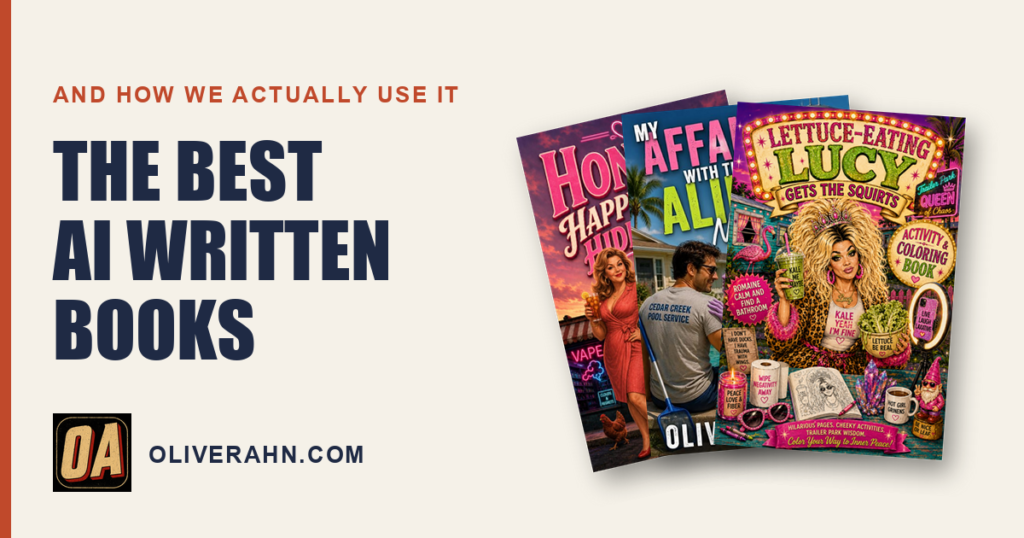
Lettuce-Eating Lucy Gets the Squirts: The Activity and Colouring Book
Where the whole thing started, and the most openly AI of anything we make, because the illustrations are generated and we have never pretended otherwise. Affirmations, activities and trailer park wisdom from the Queen of Chaos. Read the summary.
My Affair With the Alien Next Door
An alien princess hides out in small-town Florida after stealing a spaceship, and the pool guy next door works out what she is a long time after the neighbourhood has already adopted her. Warm rather than explicit. A good first one if you want to judge the writing rather than the premise. Read the summary.
Honey’s Happy Ending Hide-A-Way
Explicit, and the one we would point at to answer the question of whether an AI-assisted book can have any warmth in it. Honey Belle Hargrove wanted to be a psychologist and instead runs a small unconventional business in a Tennessee strip mall, where her clients turn out to need a great deal more than they came in for. Full story here, or read the summary on Amazon.
I Faked a Robbery for Content
A rage-baiter novel about a man who stages a crime for engagement and gets exactly the audience he asked for. This one came out closest to the voice we are always chasing, which is the whole reason we keep doing this. Full story here, or read the summary on Amazon.
Earl’s Cussin’ and Fishin’ on the Strait of Hormuz
The odd one out, and we are including it because this post is about honesty. It came out quieter and more literary than we intended, which was not the plan, and we published it anyway to see whether readers wanted that version of us. A useful reminder that steering a draft is a real skill and we do not always get it right. Full story here, or read the summary on Amazon.
One honest note
Plenty of readers do not want AI anywhere near a book, and that is a completely reasonable position to hold. We are not going to argue you out of it, and we would rather you knew before you spent money than found out afterwards and felt cheated.
What we will say is this. The tool does not decide what is funny, it does not know what a person would actually do, and left alone it writes something safe and forgettable every single time. The work is in the deciding and the cutting, and there is a lot more of both than anybody expects.
If you want to see what that actually produces, the odd and unusual list is the tamer end, funny erotic books is decidedly not, or just browse the full catalog and judge for yourself.