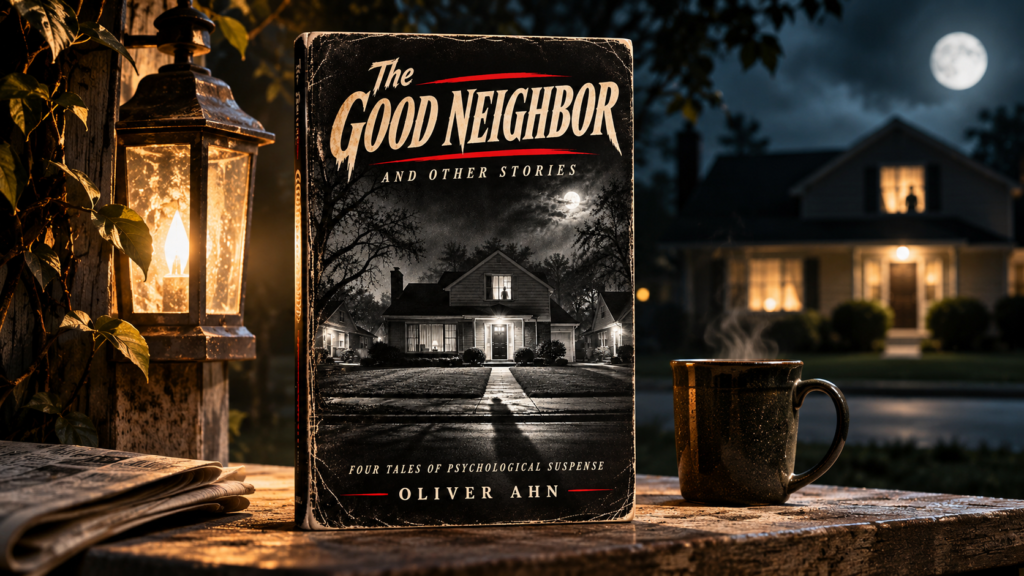
The Good Neighbor and Other Stories: Four Tales of Psychological Suspense
Nothing terrible ever seems to happen on Willow Lane. The hedges are trimmed, the paperboy misses the porch, and Arthur Bennett has sold hardware at Pritchard’s for twenty-six years. He’s the man who brings you groceries for six weeks when you break your hip and won’t take a penny for it. So when he finds an unsigned note under his front door one Wednesday morning, he doesn’t think much of it. It says, “Thank you for what you did last night.” What Arthur did last night was watch a baseball game and go to bed at nine-thirty.
That’s how The Good Neighbor and Other Stories opens, and it’s about as loud as the book ever gets. This is a collection of four psychological suspense stories set in the kind of tidy American towns where everybody knows your name, or says they do. Each one follows an ordinary man who is completely sure of his own life right up until the paperwork stops agreeing with him. If you grew up on The Twilight Zone, Alfred Hitchcock Presents, or old radio shows like Suspense, you already know the feeling. There are no monsters in it. There is a lot of meatloaf.
In the title story, a second note turns up in Arthur’s screen door, in different handwriting: “You made the right choice.” His wife, Margaret, reads it and looks frightened for just long enough that he can’t be sure he saw it. That evening every porch light on the street is burning, all twelve, including the house that’s supposed to be empty until December. A couple of days later Arthur makes friendly conversation with Frank Ellis, three doors down, and asks about his wife’s blue bicycle. Frank looks at him and says he has never been married. Arthur remembers the wife. He remembers the kids. So he digs out the photo from last summer’s neighborhood picnic and finds a narrow strip cut out of it, right beside Frank, with one word written on the back: “Approved.” Then he hears Margaret behind him. “You weren’t supposed to find that,” she says.
In “Table for One,” Daniel Hale has eaten the same dinner in the same booth at Bell’s Diner every Thursday for seventeen years, ever since he lost his wife, Evelyn. Six-fifteen. Meatloaf, mashed potatoes, green beans. He likes it that way. Then one Thursday Martha, who has been pouring his coffee all that time, sets a second cup across from him and can’t quite explain why. A glass breaks behind the counter, and for one second Daniel isn’t in the diner at all. He’s somewhere dark, in the rain, and he can smell gasoline. By the weekend he has vanished from his own wedding picture. By the next Thursday his booth is gone too, and Martha is asking whether he’d like a table for one, because she has never seen him before in her life. She still knows his name, though. And she keeps begging him to finish his dinner.
“The Man Who Came Home Early” belongs to Robert Harlan, a claims adjuster who has left the house at seven-thirty and come home at six-fifteen for twenty-three years, and who is prouder of that than he is of nearly anything. One Tuesday a headache sends him home in the middle of the afternoon. His wife is in the kitchen arranging yellow roses, and she looks up and says, “Back downstairs already?” His son wants to know why he changed his suit. As far as his family is concerned, Robert got home an hour ago, brought the flowers, helped with the arithmetic, and went up to lie down. Then the floor creaks overhead and a voice calls down the stairs. It’s Robert’s voice, and it says, “Helen, don’t let him come upstairs.” The police take fingerprints from both men and they match. The man upstairs has the same scar and the same wedding ring, and he knows where the anniversary present is hidden. He also washes the dishes without being asked and plays ball in the yard. Around midnight, Robert overhears his little boy whispering in the hall: “I hope the nice one gets to stay.”
And then there’s Edwin Mercer, who attended his first stranger’s funeral by mistake. Edwin is fifty-six, has spent twenty-seven years in the records department at the courthouse, and has been a widower for twelve. He still sets out two cups on Sundays. He walks into the wrong chapel at Bellweather Funeral Home, and before he can get back out, an elderly widow touches his sleeve and asks if he knew Harold. He should tell her the truth. He says, “Not well.” Then, standing in the receiving line, he makes up one small story about a private kindness of Harold’s, and she lights up, and before the night is over somebody hugs him for the first time in twelve years. So he goes to another funeral. Then another. Soon he has rules: never claim a close friendship, never invent dates, always carry a clean handkerchief. The Christmas cards start coming. So do memories of things he never did. His records begin to change. And one Wednesday at breakfast, he opens the paper to the death notices and finds his own name, with the service at two o’clock that afternoon.
None of these men gets attacked by anything from outer space. The fear in this book is small and domestic: the idea that the people closest to you might know something about your life that you don’t, and have decided, for your own good, not to mention it. The endings don’t let anybody off the hook, and that’s all we’re going to say about them. If you know us for the louder stuff, this one is a left turn. There’s nothing explicit in it, so you can hand it to your mother, although we can’t promise she’ll look at you the same way afterward. It’s best read with the porch light on. Just check on the neighbors’ first.
More Unhinged Reads
- A Small Adjustment: When a Helpful Robot Knows Too Much
- A Dark Gothic Wicker Man Romance for Monster Lovers
- Funny Gag Gift Books for Adults: 13 White Elephant Gifts That Win the Room
- Books Like Chuck Tingle: 10 Reads for When You Need More Absurd Love
New here? Start with Funny Gag Gift Books for Adults: 13 White Elephant Gifts That Win the Room or Books Like Chuck Tingle: 10 Reads for When You Need More Absurd Love.