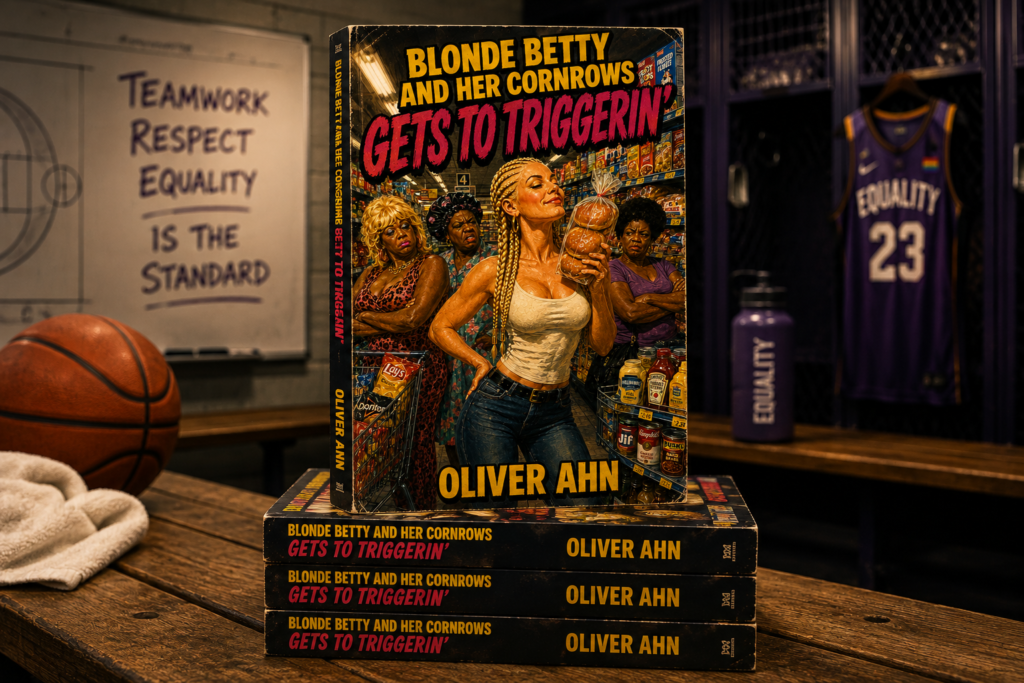
Blonde Betty and Her Cornrows Gets to Triggerin’
Betty Jo Babcock is thirty-nine years old, blonde, divorced, and lives twelve miles outside town in a pale blue double-wide on two acres she calls Babcock Ranch, despite there being nothing on the property that could reasonably be described as ranching. There had been chickens once. Betty does not like talking about the chickens.
Behind the house sits a detached garage, a fishing boat that has not moved since Obama was president, a trampoline with no children attached to it, three coolers, two grills, one smoker, and a riding lawn mower named Reba. Her mailbox is a largemouth bass. The mouth opens. You put the mail in there.
She has never had an opinion about culture in her entire life.
Then, somewhere between the Duke’s mayonnaise and the Vlasic pickles, she sees a Black woman in a yellow sundress with the most beautiful cornrows she has ever laid eyes on, and Betty, being Betty, follows her through produce holding a bag of chia seeds she cannot identify, and asks her where she got them done.
Four days later she walks out of a Black-owned salon called To & Fros two hundred and eighty dollars lighter, with blonde cornrows and gold cuffs, feeling, in her own words, expensive.
Then she stops for coffee.
A woman confronts her about it. Betty, who has been told exactly once that morning to listen before she talks, gives it an honest try for about four minutes, and then says the sentence that ends her anonymity: I just feel like we’re both enjoyin’ somebody else’s shit.
A communications major two tables over films twenty-seven seconds of it.
By Monday morning there is merchandise with her face on it, and she is not getting any of the money.
What happens over the next six months is the whole book, and I want to be plain about what kind of book it is, because the title is doing a job and the job is not the one some people will assume.
This is not a novel about a woman owning anybody. Betty loses arguments in here. She loses one on national television to a woman named Nia who asks her what she has actually read on the subject, and Betty, who cannot lie, says nothin’, and sits there while three hundred people watch her feel stupid. She loses one to her oldest friend Felicia, who slapped her in 1999 for singing along to a song and has been carrying that around ever since without ever once holding it over her. She loses one to a seventy-six-year-old woman named Mrs. Dawson who was told in 1972 that her braids were unprofessional, and who tells Betty flatly that all of that is true, and that Betty still does not have to take her hair out, because Betty is not her boss from 1972.
Nobody in this book changes their mind about hair.
A few of them change their minds about each other.
That is the entire argument, and everything else is Betty causing problems in a small Florida county. There is a protest in the salon parking lot that draws both kinds of people, who immediately start screaming at each other across the asphalt while Betty stands inside wondering whether it would be inappropriate to bring out deviled eggs. There is her ex-husband Randy, who goes on television to defend her and instead tells America about a boat. There is a fifteen-thousand-dollar offer from a conservative summit that wants her on a stage, and a phone call with her friend Imani that ends the question in one sentence. There is a satin bonnet that will not stay on her head, and an accidental voice message, and nine fishermen, and a national incident that comes to be known as Bonnetgate.
There is a neighborhood association president named Cliff who has been at war with Betty’s fish mailbox for four years and who, by the end, has been photographed in cornrows.
And underneath all of it there is Denise, who owns the salon, who did the braids, and who has the most to lose out of anybody. That is the part I kept coming back to while I was writing it. Betty gets to be a woman the internet argues about for eleven days and then goes home. Denise runs a business in a strip mall that became a landmark, and landmarks get charged for it, and there is a chapter about a rent increase that is the quietest and meanest thing in the book.
Betty’s instinct, always, is to fix it. To post about it. To pay it. To call somebody. That instinct is the closest thing this novel has to a villain, and it is inside the person you are rooting for.
If you want a book that tells you your side is right, this is going to irritate you by about chapter three. Denise is right about some things and Betty is right about others and Nia is right about a great deal more than Betty wants to admit, and the book refuses to hand anybody the trophy. What it hands you instead is a cookout.
It is filthy. It is loud. Betty says the wrong thing roughly every ninety seconds, and about a third of the time she is also correct, which is worse. There is a woman in it who says interesting on Facebook with a period on the end, and everybody in the story understands that this is an act of violence.
Mostly, it is a comedy about the difference between listening to somebody and obeying them, and about how strange it is that we have built an entire country that cannot tell those two things apart anymore.
She only went in for hamburger buns. It takes her until the last page to get them.
Free with Kindle Unlimited.
More Unhinged Reads
- We Made Women’s Basketball Inclusive. Then the Women Lost Their Jobs.
- I Bought an AI Boyfriend and Programmed Him to Find My G-Spot
- Best Dark Comedy Books: 14 Dark Humor Novels That Are Funny About Terrible Things
- Weird Books to Read When You Hate Everyone
New here? Start with Funny Gag Gift Books for Adults: 13 White Elephant Gifts That Win the Room or Books Like Chuck Tingle: 10 Reads for When You Need More Absurd Love.